Minimize Customer Churn: A Diagnostic-First Playbook

Quick answer
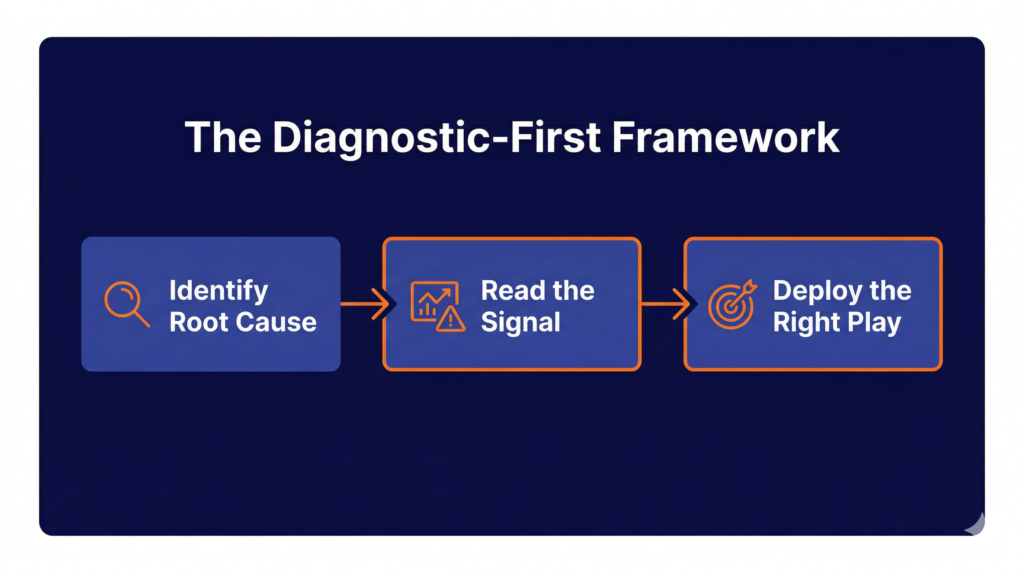
Minimizing customer churn means diagnosing the root cause behind each cancellation — Poor Fit, Low Engagement, Budget Pressure, Champion Departure, or Involuntary (failed payment) — and matching the intervention to that cause instead of applying blanket tactics. Segment the plays by ARPA tier: automate everything at self-serve, pair health-score alerts with CSM-triggered outreach at mid-market, and run high-touch multi-stakeholder engagement at enterprise. When a save-offer is needed, follow the hierarchy pause → downgrade → discount — in that order, and only after the root cause is identified.
Customer churn drains more recurring revenue from SaaS businesses than almost any other failure mode — and most of that loss is preventable.
Harvard Business Review has reported that acquiring a new customer runs anywhere from 5–25x more expensive than retaining an existing one, yet most retention programs still rely on generic playbooks that treat every cancellation the same way.
That’s the core problem: you can’t minimize customer churn without first knowing why it’s happening. Applying “improve your onboarding” to a customer churning because of budget pressure won’t work.
Offering a discount to a customer who’s a poor ICP fit only delays the inevitable — and trains future customers to expect a discount before renewing.
This guide takes a different approach. Instead of a list of tactics, you’ll get a diagnostic-first framework that maps the five root causes of B2B SaaS churn to specific, segment-tested plays — including working targets by ARPA tier, early warning signals, and a structured save-offer hierarchy that protects both revenue and brand integrity.
Want to see your root-cause breakdown?
Find out which churn driver is costing you the most MRR.
What “Minimize Customer Churn” Actually Means (and Why Generic Tactics Fail)
Minimizing customer churn is not about applying more tactics — it’s about applying the right tactic to the right problem. Churn is a symptom, and like any symptom, treating it without a diagnosis leads to wasted effort and, often, accelerated loss.
For B2B SaaS teams managing recurring revenue, this distinction directly affects MRR, NRR, and long-term growth trajectory.
Before choosing any retention play, two definitions must be clear:
Voluntary vs. Involuntary Churn: Why the Split Matters
Voluntary churn happens when a customer actively decides to cancel — because the product no longer fits their needs, their budget changed, or their internal champion left the company.
Involuntary churn happens without intent: a failed payment, an expired card, or insufficient funds ends the subscription automatically.
The critical data point: industry analyses consistently estimate that involuntary churn accounts for 20–40% of all SaaS churn.
That means up to 4 in 10 cancellations you’re experiencing right now have nothing to do with product value or customer satisfaction — and can be recovered with a proper dunning system, without any save-offer conversation required.
Key insight: Up to 40% of your churn may be involuntary — caused by failed payments, not dissatisfied customers. A dunning system alone can recover a significant share of that MRR before any human intervention is needed.
The Most Common Mistake Teams Make When Trying to Reduce Churn
The mistake isn’t inaction — it’s undifferentiated action. Most CS teams apply the same three plays to every at-risk account: a check-in call, a product tip email, and eventually a discount.
But a customer churning because their champion left the company needs stakeholder re-engagement, not a discount.
A customer churning due to poor ICP fit needs an honest conversation about product scope, not another onboarding session.
The cost of this error is significant. Bain & Company research popularized by Harvard Business Review — Frederick Reichheld’s loyalty findings from the 1990s and 2000s — associated a 5% improvement in retention with profit increases of 25–95%. That improvement only materializes when interventions are matched to root causes.
Generic plays dilute the signal, exhaust the CS team, and train customers to expect concessions.
For a broader look at how proactive retention strategies are structured across SaaS companies, see our guide on customer retention strategy for SaaS.
The 5 Root Causes Behind Customer Churn (And How to Spot Them)
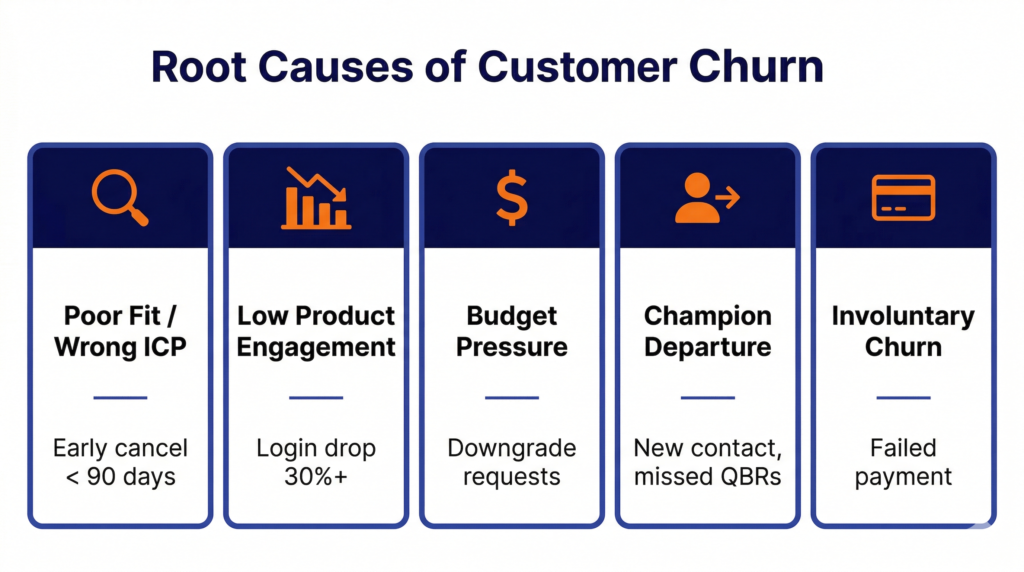
The five root causes of customer churn in B2B SaaS are: (1) Poor Fit/Wrong ICP, (2) Low Product Engagement, (3) Budget Pressure, (4) Champion Departure, and (5) Involuntary (Failed Payment).
Each has a distinct signal pattern and requires a different intervention. Applying the wrong play not only fails to retain the customer — it wastes CS capacity and can damage the relationship.
1. Poor Fit / Wrong ICP
The customer was acquired outside your Ideal Customer Profile — wrong industry, wrong team size, or wrong use case.
These accounts rarely reach activation and often churn within the first 90 days. Signals: low activation rate, feature mismatch in support tickets, cancellation within the first 60–90 days, weak engagement with core workflows.
Play: Don’t save this customer with a discount. The right intervention is an honest scope conversation — and, upstream, an ICP audit to prevent the same mistake in acquisition.
2. Low Product Engagement
The customer activated but never built a usage habit.
They’re paying but not extracting value, which makes every renewal conversation a negotiation rather than a celebration. Signals: login frequency drop of 30%+, feature abandonment, zero active integrations, no team members added after onboarding.
Play: Proactive CSM outreach tied to a health score alert, in-app re-engagement nudges, and a structured “second onboarding” focused on one high-value use case.
3. Budget Pressure
An external financial event — cost-cutting round, budget reallocation, new CFO scrutiny — puts your subscription on the chopping block. The customer may still value the product but can’t justify the spend.
Signals: downgrade requests, payment delays, ROI justification questions from stakeholders who weren’t previously involved.
Play: Downgrade before discount. Offer a lower tier that preserves the relationship rather than a discount on the current plan. See the save-offer guardrails in H2 4 below.
4. Champion Departure
Your internal advocate — the person who bought, implemented, and defended your product — left the company or changed roles.
The new stakeholder has no history with your product and no emotional investment in its success.
Signals: new contact listed on the account, missed QBRs, sudden disengagement after a previously healthy relationship.
Play: Champion succession protocol — proactively map 2–3 stakeholders per account during onboarding, not only after the departure occurs.
5. Involuntary Churn (Failed Payment)
No intent to cancel. The subscription ended because of a payment failure — expired card, bank decline, insufficient funds.
Signals: failed payment notification, subscription in “past due” status, no response to payment update requests.
Play: Automated dunning sequence with smart retry logic. This root cause is the highest-ROI intervention in retention because it requires no product change, no negotiation, and no CS time.
How to Minimize Customer Churn by Segment (Self-Serve, Mid-Market, Enterprise)
The right retention play depends on your ARPA tier — not just on the root cause. A self-serve SaaS company at $49/month per seat cannot deploy the same playbook as an enterprise team with $15k ACV accounts.
The economics are different, the available CS capacity is different, and the interventions that are worth the effort are different.
As working targets by segment: enterprise SaaS teams should hold monthly churn to 0.3–0.8%, mid-market teams to 1–2%, and SMB or self-serve products to 2–4%. These targets set the baseline for what “good” looks like before you invest in any play — for a full breakdown by industry and ARR stage, see the ChurnDefense SaaS churn benchmarks.
Self-Serve SaaS (below $500 ARPA) — Automate Everything
At this ARPA tier, no CS motion is economically viable at scale. Every retention play must be automated, triggered by behavioral signals, and designed to work without human intervention.
- In-app nudges triggered when login frequency drops below a defined threshold (e.g., no login in 7 days)
- Automated dunning sequence for failed payments — smart retry logic with 3–5 touch points across email and in-app before cancellation
- Cancellation flow with a pause option — offering a 1–2 month pause before full cancellation recovers a measurable share of would-be churners, particularly in Budget Pressure scenarios
- Annual plan prompts at key engagement milestones — annual subscribers churn at a fraction of the rate of monthly customers, making the pricing nudge one of the highest-leverage moves available at this tier
The goal at self-serve is not to talk to every at-risk customer — it’s to build a system that handles the most common root causes (Low Engagement, Involuntary, Budget Pressure) before a human ever needs to be involved.
Mid-Market SaaS ($500–$5k ARPA) — Hybrid: Health Score + Human Trigger
At this tier, CS capacity exists but is finite. The play is a health score model that surfaces at-risk accounts automatically and routes them to a CSM only when the signal crosses a defined threshold — not for every account, every week.
- Health score alert system combining product engagement (login frequency, feature adoption, integrations), financial signals (payment status, plan tier changes), and relationship signals (QBR attendance, support ticket volume)
- CSM-triggered outreach tied to the alert — not a generic check-in, but a conversation structured around the specific signal that fired (e.g., “I noticed your team’s usage dropped 40% over the last 3 weeks — what changed?”)
- Personalized save-offer for Budget Pressure accounts — following the hierarchy in H2 4 below: pause first, downgrade second, discount last
- Cohort analysis to identify which onboarding paths lead to the highest 6-month retention — then reinforce those paths for new accounts
A structured health score system — like the one inside ChurnDefense — eliminates the manual account review cycle that burns CS capacity without proportional retention results, surfacing at-risk accounts the moment a signal fires instead of at the next scheduled review.
Enterprise SaaS (above $5k ARPA) — High-Touch, Multi-Stakeholder
At enterprise ARPA, every churned account is a material revenue event. The plays are high-touch by design, and the investment in each relationship is justified by the LTV at risk.
- Quarterly Business Reviews (QBRs) with ROI documentation — renewal conversations should start 90–120 days before the contract end date, not at renewal time
- Champion succession protocol — map 2–3 stakeholders per account during onboarding, maintain an executive sponsor relationship, and trigger a re-engagement sequence automatically when a key contact goes dark
- Multi-stakeholder engagement — at enterprise, the “champion” and the “economic buyer” are rarely the same person; both need to be actively engaged throughout the contract lifecycle
- Expansion-first mindset — the target metric at enterprise is NRR above 110%, which means churn prevention and upsell are managed as a single motion, not separate workstreams
Plays by ARPA Tier
| Tier | ARPA | Churn Target | Primary Play |
|---|---|---|---|
| Self-Serve | < $500 | ≤ 4% / month | Automated dunning + in-app nudges + pause option |
| Mid-Market | $500–$5k | ≤ 2% / month | Health score alerts + CSM-triggered outreach + save-offer |
| Enterprise | > $5k | ≤ 0.8% / month | QBRs + champion succession + multi-stakeholder engagement |
Not sure which plays to prioritize for your ARPA tier?
See how ChurnDefense structures the diagnostic workflow for your team.
Save-Offer Guardrails — The Hierarchy That Protects Revenue and Brand
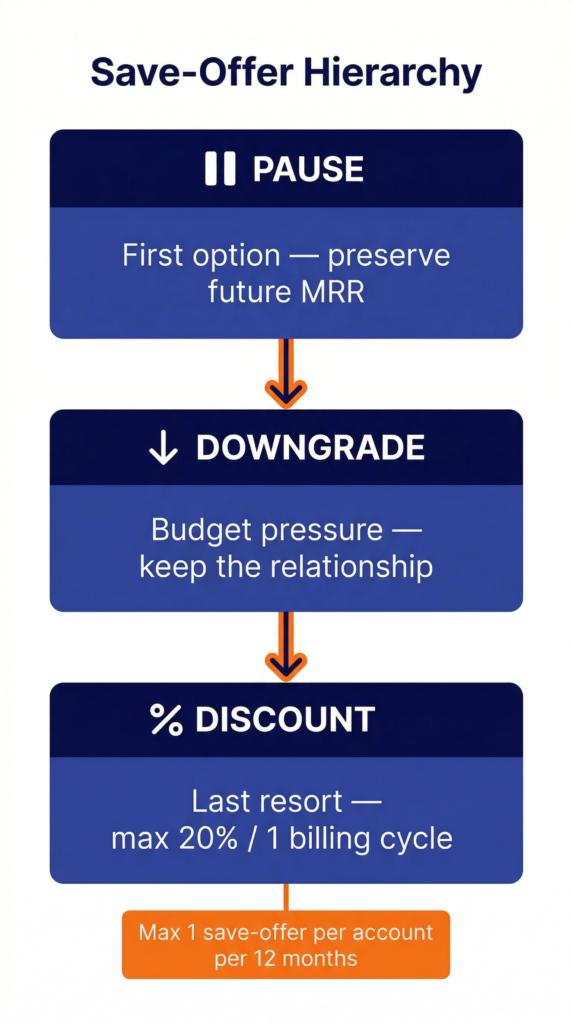
Not every at-risk customer deserves a discount. Before offering anything, diagnose the root cause. The correct save-offer hierarchy is: pause → downgrade → discount — in that order, and only after the root cause has been identified.
Skipping this sequence is one of the most common ways CS teams erode margin while believing they’re protecting retention.
Step 1: Pause — The Highest-Value First Move
A pause option gives the customer a 1–2 month break from billing without fully canceling the subscription. It’s the best first intervention for Budget Pressure and for customers going through internal transitions (team change, reorg, seasonal slowdown).
Why it outperforms a discount as a first move: the customer remains in your system, their data stays intact, reactivation is frictionless, and you preserve future MRR without setting a pricing precedent.
A discount, by contrast, immediately reduces recognized revenue and creates an expectation that concessions are available on demand.
Step 2: Downgrade — Save the Relationship, Protect the Unit Economics
If a pause isn’t viable — because the root cause is longer-term budget pressure, not a temporary event — a downgrade to a lower tier is the right second step. The customer continues paying, the relationship is preserved, and the path to re-expansion remains open.
Downgrading a Budget Pressure account is also far more honest than offering a discount on a plan that no longer fits their current usage. A customer on a $500/month plan using 20% of its features is a better candidate for a $150/month plan than for a 20% discount on $500.
Step 3: Discount — Last Resort, With Hard Limits
Discounts should only be offered when pause and downgrade have been considered and ruled out, and only when the root cause is genuinely Budget Pressure — not Poor Fit, not Low Engagement, not Champion Departure.
Offering a discount to a Poor Fit customer extends a relationship that has no future value for either side.
When a discount is the right call, apply these guardrails without exception:
- Maximum discount: 20% of the current plan value
- Maximum duration: 1 billing cycle — not ongoing, not auto-renewing
- Frequency cap: 1 save-offer per account per 12 months — no exceptions
The reason for the frequency cap is behavioral: customers who receive a discount before canceling once will expect the same option before canceling again.
Over time, this pattern trains your customer base to use cancellation as a pricing negotiation tactic — a dynamic that systematically reduces NRR and is very difficult to unwind once established.
Guardrail: Never offer a discount before diagnosing the root cause. Discounting a Poor Fit customer prolongs a relationship without value for either side — and trains your base to expect concessions at renewal. The hierarchy is always: pause → downgrade → discount.
Early Warning Signals — How to Catch Churn Before It Happens
Most churning customers show clear warning signals weeks before they cancel.
The difference between a proactive retention team and a reactive one isn’t intuition — it’s whether those signals are being systematically captured, scored, and routed to the right intervention before the customer reaches a cancellation decision.
The challenge is that churn signals don’t arrive in a single dashboard. They’re spread across product analytics, billing systems, CRM activity logs, and support ticket data.
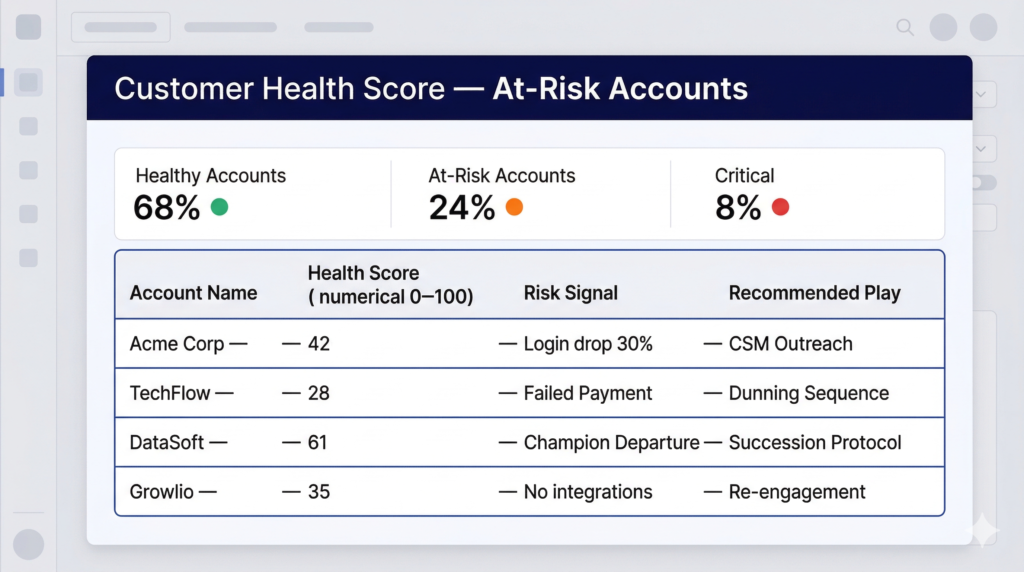
Teams that consolidate these signals into a single health score model catch at-risk accounts weeks earlier than teams relying on manual account reviews or gut instinct from CSMs.
Product Usage Signals — The Earliest and Most Reliable Indicators
Usage data is the strongest leading indicator of churn because it reflects actual customer behavior, not stated intent. A customer who tells their CSM “everything is fine” but hasn’t logged in for 21 days is showing you a different reality.
The key thresholds to monitor:
- Login frequency drop of 30%+ over a 2-week rolling window — the single most predictive signal across most SaaS product categories
- Feature abandonment — the customer stops using the features that drove their initial purchase decision, often a sign of Poor Fit or Low Engagement root cause
- Zero active integrations — accounts with several active integrations consistently churn at far lower rates than accounts with none or one; a newly integrated account is stickier; a never-integrated account is perpetually at risk
- No new team members added after onboarding — single-user accounts churn significantly faster than accounts with 3+ active seats, because the product has no organizational depth
Financial and Billing Signals — High Urgency, Low Ambiguity
Unlike usage signals, which require interpretation, financial signals are binary and require immediate action.
- Failed payment or “past due” status — route instantly to the automated dunning sequence; every day of delay increases the probability of permanent cancellation
- Switch from annual to monthly plan at renewal — a customer moving from annual to monthly is not just changing billing preference; they’re reducing their commitment and hedging against cancellation
- Downgrade request before renewal — a direct Budget Pressure signal; trigger the save-offer hierarchy (pause → downgrade → discount) immediately, before the customer self-cancels
Relationship Signals — The Hardest to Track but Critical for Enterprise
Relationship signals are the least structured data type but matter most at mid-market and enterprise ARPA tiers, where the human relationship is a core part of the product value.
- Champion departure — a key contact going dark or a new stakeholder appearing on account correspondence is one of the highest-risk events in the customer lifecycle; trigger the succession protocol within 48 hours
- Missed QBRs or declining attendance — when a previously engaged account stops showing up to business reviews, it usually means internal prioritization has shifted; escalate to an executive sponsor
- Support ticket volume spike with unresolved escalations — rising frustration that isn’t being addressed; indicates a product or onboarding gap that needs CS intervention, not a discount
Early Warning Signal Cheat Sheet
| Signal Type | Specific Trigger | Likely Root Cause | First Action |
|---|---|---|---|
| Product | Login drop 30%+ in 2 weeks | Low Engagement | Health score alert → CSM outreach |
| Product | Zero integrations after 30 days | Poor Fit / Low Engagement | Integration setup prompt + in-app nudge |
| Billing | Failed payment / past due | Involuntary | Automated dunning sequence |
| Billing | Annual → monthly switch | Budget Pressure | Save-offer hierarchy (pause first) |
| Relationship | Champion goes dark / new contact | Champion Departure | Succession protocol within 48h |
| Relationship | Missed QBRs + unresolved tickets | Low Engagement / Poor Fit | Executive sponsor escalation |
To learn how to consolidate these signals into a unified model, see our guide on customer retention and churn benchmarks by industry.
Ready to act on these signals?
Build a Root-Cause Retention System That Works Before You Need It
The pattern is consistent: teams that diagnose root causes before deploying plays reduce churn faster and more sustainably. ChurnDefense structures that diagnostic workflow for you.