SaaS Customer Retention Strategy: The Definitive, Conversion-Ready Guide


Quick answer
Treat SaaS customer retention as an operating system, not a rescue project: diagnose churn by segment and split it into voluntary vs involuntary, fix reliability and first-week activation, recover failed payments with a dunning stack, design a cancellation flow that captures reasons and saves persuadable accounts, and route risk with a health score tied to playbooks. Then add expansion loops — seats, add-ons, tier upgrades — to push NRR to 100% or higher. This guide packages the whole system as a 90-day rollout with owners, cadences, and deliverables.
Your sales team just closed another strong month. New logos are up 40%. Marketing is celebrating. The board is optimistic.
Then you open the revenue dashboard and feel that familiar knot: MRR barely moved.
Welcome to the leaky bucket. While you sprint to fill the top of the funnel, revenue quietly drains out the bottom. The delta between winners and strugglers in SaaS is not who acquires fastest—it’s who compounds revenue from customers they already have.
This guide is your retention operating system. You’ll learn how to diagnose leaks, fix involuntary churn, design ethical cancellation flows that learn and save, build a predictive health score, and implement expansion loops that push NRR ≥ 100%—with a 90-day rollout you can start today.
Why Most SaaS Companies Get Retention Wrong
It’s not apathy—founders care about retention. The failure pattern is organizational: teams treat retention as an ad-hoc rescue project when churn spikes, rather than as a system that runs every week, across Product, CS, Growth, RevOps, and Finance.
Three anti-patterns dominate:
- The Feature Factory Reflex. Churn rises → “We need Feature X!” → roadmap bloat. You end up building for customers who already left, instead of understanding why your best customers stay.
- The Dashboard Delusion. A pretty churn dashboard is not a strategy. Knowing “churn is 5%” doesn’t tell you where or why to intervene. Strategy = segments + interventions + accountable owners.
- Acquisition Addiction. It’s sexier to ring the bell for a $50k deal than to quietly prevent a $5k churn. But the ROI math is brutal: it’s vastly cheaper to retain and expand than to reacquire equivalent revenue.
Mindset shift: treat retention as the growth heartbeat. Think in pairs:
-
Logo churn (customers) and revenue churn (MRR)
-
GRR (stickiness, excludes expansion) and NRR (includes expansion & contraction)
The Growth Math (and why NRR rules)
If your GRR is the leak rate (how much revenue the bucket keeps without expansion), NRR is the flywheel (how much it grows from the same cohort after expansion minus contraction). Companies with NRR ≥ 100% can grow even if net new slows, because existing customers compound.
Targets (directional, calibrate to your model):
- GRR (B2B mid-market): strive for ≥ 85%
- NRR: get to ≥ 100%, then build toward 110–120% via expansion motions
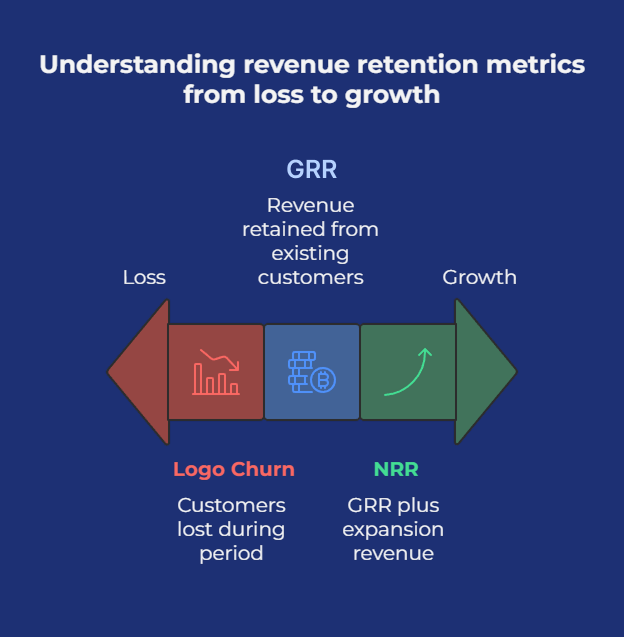
What is GRR?
Revenue retained from an existing cohort excluding expansion.
What is NRR?
GRR adjusted by expansion and contraction—your compounding engine.
Step 1 — Diagnose Before You Prescribe (Days 1–14)
Download the SaaS Retention Template (XLSX)
Stop looking at aggregates. Segmentation converts anxiety into action.
Slice churn by: plan/ARPA, ICP tier, region, acquisition channel (self-serve vs sales-led), lifecycle stage (onboarding vs mature), product area, and payment method. Label each churned account Voluntary (explicit cancel) or Involuntary (payment failure).
Map a retention funnel from signup → first value → activation → weekly usage → adoption depth → renewal. Identify drop-off cliffs (e.g., “never reached first value,” “activated then decayed,” “adopted but no ROI story,” “competitive displacement”).
Find the persuadables. Don’t only target “highest risk.” Use uplift thinking: who’s likely to change behavior if we intervene? Save programs win when they focus on the movable middle, not the extreme right tail.
Deliverables by Day 14:
- Segmented GRR/NRR dashboard with voluntary vs involuntary split
- Top 5 leak segments with root-cause hypotheses
- List of persuadable cohorts + contact rules (owner, SLA, channel)
Step 2 — Fix Foundations First (Weeks 3–4)
2.1 Reliability is non-negotiable
If the product is slow or unstable, no save offer will stick. Burn down P0 bugs and latency hotspots before fancy experiments.
2.2 Activation that predicts retention
Define your first value (“aha”) and a first-week success checklist for each ICP role (admin/end-user).
-
In-product nudges (checklists, coach-marks, progressive disclosure) with fatigue controls
-
Email/SMS sequences triggered by events, not dates
-
Role-aware onboarding paths (admin needs different steps than a contributor)
2.3 The trust transfer (Sales → CS)
Make kickoff feel like continuity, not a cold start. CSM references sales context: goals, constraints, promised outcomes, success measures.
Before building any retention strategy, your team needs a reliable baseline number. That starts with calculating your Customer Retention Rate correctly — including the difference between logo retention and revenue retention (GRR), which most SaaS teams conflate. For a complete breakdown of the formula, variations by segment, and 2026 benchmarks, see our guide to the customer retention rate formula for SaaS.
Step 3 — Involuntary Churn: The Silent Revenue Leak (Ship in 1–2 weeks)
In many subscription businesses, 20–40% of overall churn is involuntary — passive payment failure, per Paddle's guide to voluntary vs. involuntary churn. Treat this as RevOps, not back-office.
Playbook:
-
Card updater / network tokens (Visa/MC) + updater webhooks
-
Smart retries tuned by issuer codes, time-of-day/day-of-week, and amount
-
Localized dunning (sender, language, currency) with reason-specific copy
-
In-app banners/modals with one-click update (not just email)
-
Pre-expiry nudges (cards expiring in 30 days)
-
Pause state as a first-class citizen (graceful safety valve vs forced cancel)
Win condition: measurable drop in involuntary churn without touching pricing or product scope.
Step 4 — Voluntary Churn: Design the Cancellation Path (Weeks 5–6)
Hiding the cancel link creates brand drag and fewer insights. Design the experience to learn and save—ethically.
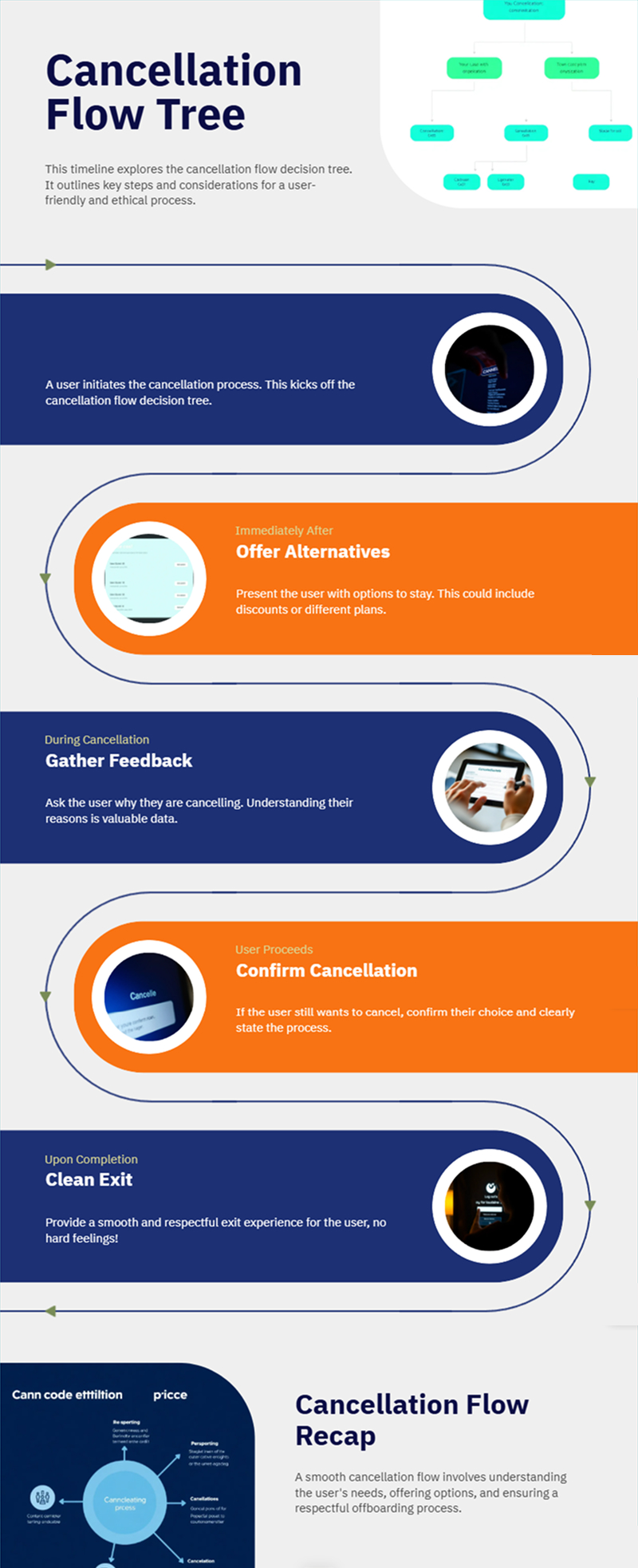
Anatomy of a modern cancel flow:
-
Reason capture first (micro-survey: 5–7 options + “other”).
-
Branching saves personalized by reason:
-
Too expensive → time-boxed discount or downgrade with value recap
-
No time / not using → pause/hibernate for 1–3 cycles + auto-resume reminder
-
Missing feature → roadmap transparency, workaround, “notify me when shipped”
-
Switched to competitor → exit interview, 90-day check-in
-
-
Loss aversion: show what they’ll lose (history, config, current price).
-
Friction-free exit (no dark patterns) + self-serve data export.
-
Reason-specific win-back cadences (30/60/90 days or when a feature ships).
Outcome: higher save-rate, structured reason data, better roadmap, better brand sentiment.
Should we gate cancellation behind chat?
No. Provide self-serve cancel with optional help. Forced friction reduces trust and increases negative WOM.
Step 5 — Health Scoring That Predicts (and Triggers Action)
A good health score is not a vanity color—it’s a routing engine.
Signals to combine:
-
Usage: login velocity, feature depth, seat utilization vs purchased
-
Billing: invoice aging, payment method risk, renewal window proximity
-
Sentiment: support volume/severity, CSAT/NPS, escalation flags
-
Engagement: education/modules consumed, community participation, webinar/training attendance
Design principles:
-
Start transparent (simple weights), back-test quarterly and re-weight.
-
Define R/A/G thresholds with playbooks:
-
Red: CSM call ≤48h, exec sponsor for high ARR, remediation plan (3 actions/14 days)
-
Amber: automated education journey + office hours
-
Green: expansion prompts, advocacy asks, case study outreach
-
Make it actionable: connect health transitions to tasks (CSM queue), alerts (Slack/Email), and product prompts (education or upgrade CTAs).
Download the 14-Day Retention X-Ray Checklist (XLSX)
How accurate should a health score be?
Useful > perfect. If it drives timely, effective actions, iterate accuracy later.
Step 6 — Expansion Loops (How You Cross NRR 100%)
Retention keeps the bucket full; expansion makes it overflow. Build repeatable motions:
-
Seat growth: product-led prompts (“8/10 seats used”), frictionless add-seat flows; sales-assist for larger upsells
-
Feature add-ons: analytics, governance, SSO, advanced integrations—priced to value, not cost
-
Tier upgrades: packaging aligned to maturity/risk (SLA, security, admin controls)
-
Usage-based edges: polite thresholds with in-context upgrade CTAs
Timing rules: don’t solicit expansion while health is sliding. Trigger upsell when value is evident (new team invites, feature streaks, quota thresholds).
Run an Expansion Opportunity Audit
Download the free Expansion Opportunity Audit template (XLSX)
Metrics That Matter (and how to read them)
-
GRR (12 months): baseline stickiness. If GRR is weak, you’re plugging holes; expansion won’t mask structural leaks.
-
NRR (12 months): compounding outcome. March to ≥ 100%, then push higher with proven expansion plays.
-
Voluntary vs involuntary split: separate dashboards, separate owners, separate OKRs.
-
Health distribution (Green/Amber/Red) over time: your pipeline of risk and upsell.
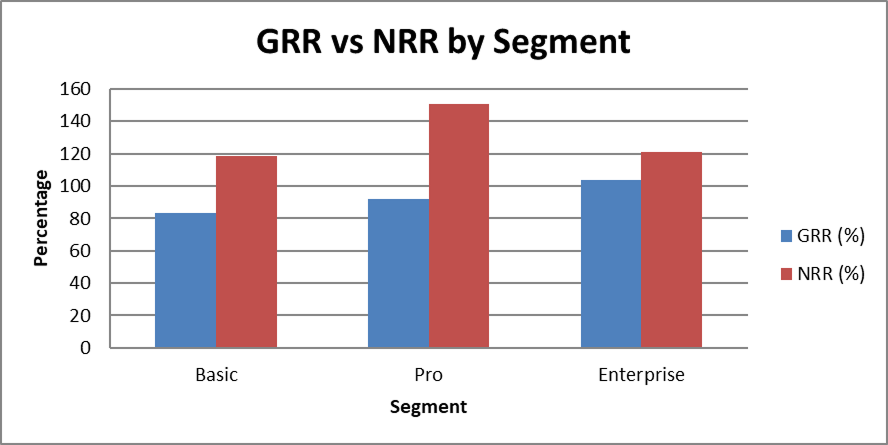
As a rule of thumb, both retention and expansion tend to rise with ARPA: self-serve SMB cohorts churn faster and expand less, while enterprise cohorts retain better and increasingly grow through expansion. For sourced retention and churn numbers by vertical, see our customer retention and churn benchmarks by industry.
90-Day Retention Transformation Plan (owner, cadence, deliverables)
Days 1–14 —
X-ray & Ownership
-
Appoint a Retention Owner (single throat to choke).
-
Ship segmented GRR/NRR + voluntary/involuntary split and cohort curves.
-
Identify persuadables + write outreach rules (who, when, via what).
-
Start a weekly Retain Board (Product, CS, Growth, Finance).
Days 15–45 —
Foundations & Involuntary
-
Reliability SLOs + P0 bug burndown.
-
Dunning v1: card updater, smart retries, localized comms, in-app banner.
-
Pre-expiry nudges; pause option for short-term risk.
Days 46–70 —
Voluntary v1 & Activation
-
Cancel flow v1 (reason capture → branching saves → clean exit).
-
First-week activation revamp (role-based checklist, contextual nudges, event-triggered comms).
Days 71–90 —
Health + Expansion
-
Health score v1 + playbooks; wire alerts to CSM/tasking.
-
First expansion motion (seats or add-on) with in-product prompts.
QBR-style internal review: what moved GRR/NRR; where to double-down.
Real-World Wins (mini case studies)
The scenarios below are illustrative composites of the plays in this guide — directional patterns, not sourced case studies:
- Onboarding first-value lift. Imagine a B2B SaaS that redesigns onboarding around a 15-minute “first value” path with role-based checklists: 30-day churn drops meaningfully because new accounts reach value before their first renewal decision.
- Dunning + payment UX. A mid-market vendor that ships network tokens, a tuned retry ladder, and in-app payment banners recovers a large share of failing payments — passive churn falls without touching pricing or product scope.
- Cancel flow redesign. A team that replaces blanket discounts with pause options and quick tutorials sees save-rates climb, because offers finally match cancel reasons.
- Health-driven expansion. A data platform that prompts seat growth after power-use milestones and packages advanced analytics as a paid add-on turns its health score into an expansion engine that lifts NRR.
Common Pitfalls (and how to avoid them)
-
Building for the churned. Talk to retained power users as much as churned users.
-
Hiding cancel. You lose insight and trust; design cancel to learn and save.
-
Black-box scores. If teams don’t trust the health score, they won’t act on it.
-
Expansion during pain. Never upsell when accounts are red. Fix value first.
-
Vanity metrics. Celebrate NRR improvements tied to specific plays—not just “engagement.”
Tooling Stack (pragmatic minimum)
-
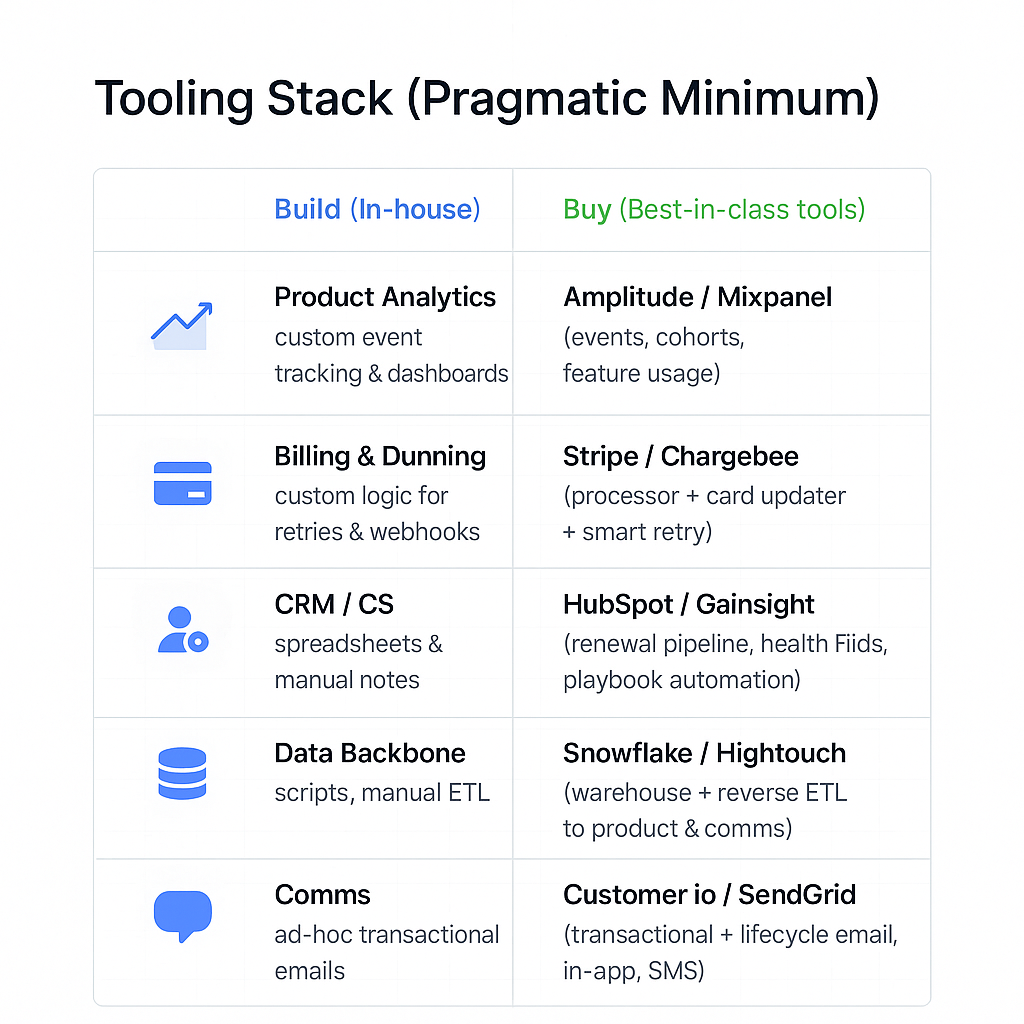
Product analytics: events, cohorts, feature usage (Amplitude/Mixpanel)
-
Billing & dunning: processor + card updater + smart retry
-
CRM/CS: renewal pipeline, health fields, playbook automation
-
Data backbone: warehouse + reverse ETL to send segments into product & comms
-
Comms: transactional + lifecycle (email, in-app, SMS)
Templates & Downloads
- 14-Day Retention X-Ray Checklist (XLSX)
- Dunning Ladder & Email Pack (XLSX)
- Cancellation Flow Decision Tree (image)
- 90-Day Retention Plan Checklist (XLSX)
See your save-rate and recoverable MRR in 48 hours.
Get a free Retention & Dunning Audit
(we’ll return a teardown + prioritized roadmap)
What’s a “good” churn rate for B2B SaaS?
It depends on model and ARPA, but anchor on GRR and NRR. Many mid-market B2B teams target GRR ≥ 85% and NRR ≥ 100%, then expand to 110–120% with proven upsells.
Should I hide the cancel link to reduce churn?
No. Hiding erodes trust and kills insight. Use reason capture, branching saves, and a clean exit. You’ll save more accounts and speed product learning.
What signals belong in a health score?
Usage depth/breadth, billing risk, support sentiment, engagement with education. Start transparent; re-weight quarterly based on renewal outcomes.
Where do I start if I have limited bandwidth?
Fix involuntary churn first (fast ROI). In parallel, define first-week activation and ship a basic cancel flow. Health score v1 next; then expansion.
How do I avoid discount addiction in saves?
Lead with pause/downgrade/education, not blanket discounts. When you do discount, time-box and pair with value catalysts (training, setup).